

Code of Conduct
Code of Conduct
Our Beliefs
-
Victorians learn best in an environment of order and discipline. They also need care, encouragement and space to learn from mistakes and grow in character.
-
Discipline is an educative process. Its goal is to instil self-discipline and good character so that every Victorian becomes a Gentleman, Sportsman and Leader.
-
Consequences provide opportunities for learning and responsibility, not punishment. We apply them fairly, firmly and appropriately to guide Victorians in living out our school’s direction.
Our Expectations
Every Victorian sets high expectations for himself as a Gentleman, Sportsman and Leader who serves and leads his family, community and country.
-
As Gentlemen, Victorians act with integrity and take responsibility for their decisions and actions. They learn from experiences and grow into kind, respectful and upright young men who uphold our school values.
-
As Sportsmen, Victorians exercise self-discipline and take personal responsibility. They build strong relationships through empathy, cooperation and understanding.
-
As Leaders, Victorians serve others and contribute to a safe and positive learning environment. They honour school rules, value community and uplift those around them.
Our Approach
-
Our approach to student management reflects our commitment to student wellbeing and holistic development. We focus on helping Victorians learn and grow from their actions. We are firm in our standards and fair in our judgement.
-
Every student is treated with dignity, impartiality and empathy. We uphold clear standards consistently to nurture integrity and resilience.
-
We set and communicate high standards of behaviour that reflect our school direction and values. When misconduct occurs, we address it promptly and fairly, taking time to understand the context.
-
Opportunities for reflection and restoration are built into our approach. Applied with proportionality and compassion, they help Victorians take responsibility, repair trust and strengthen relationships.
Our Standards
1. Personal Conduct and Grooming
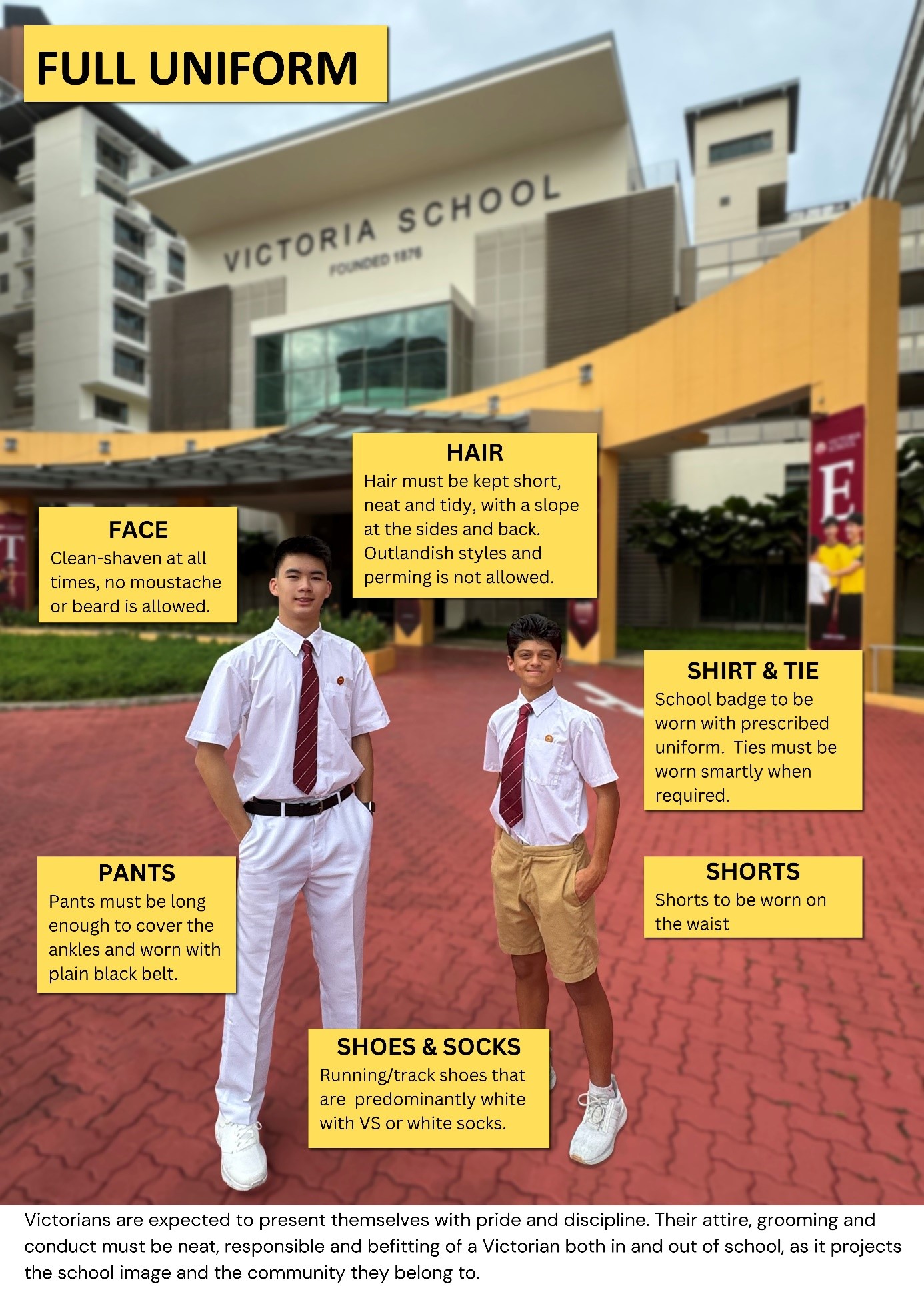
1.1 Victorians are expected to present themselves with pride and discipline. Their attire, grooming and conduct must be neat, responsible and befitting of a Victorian both in and out of school, as it projects the school image and the community they belong to.
Uniform
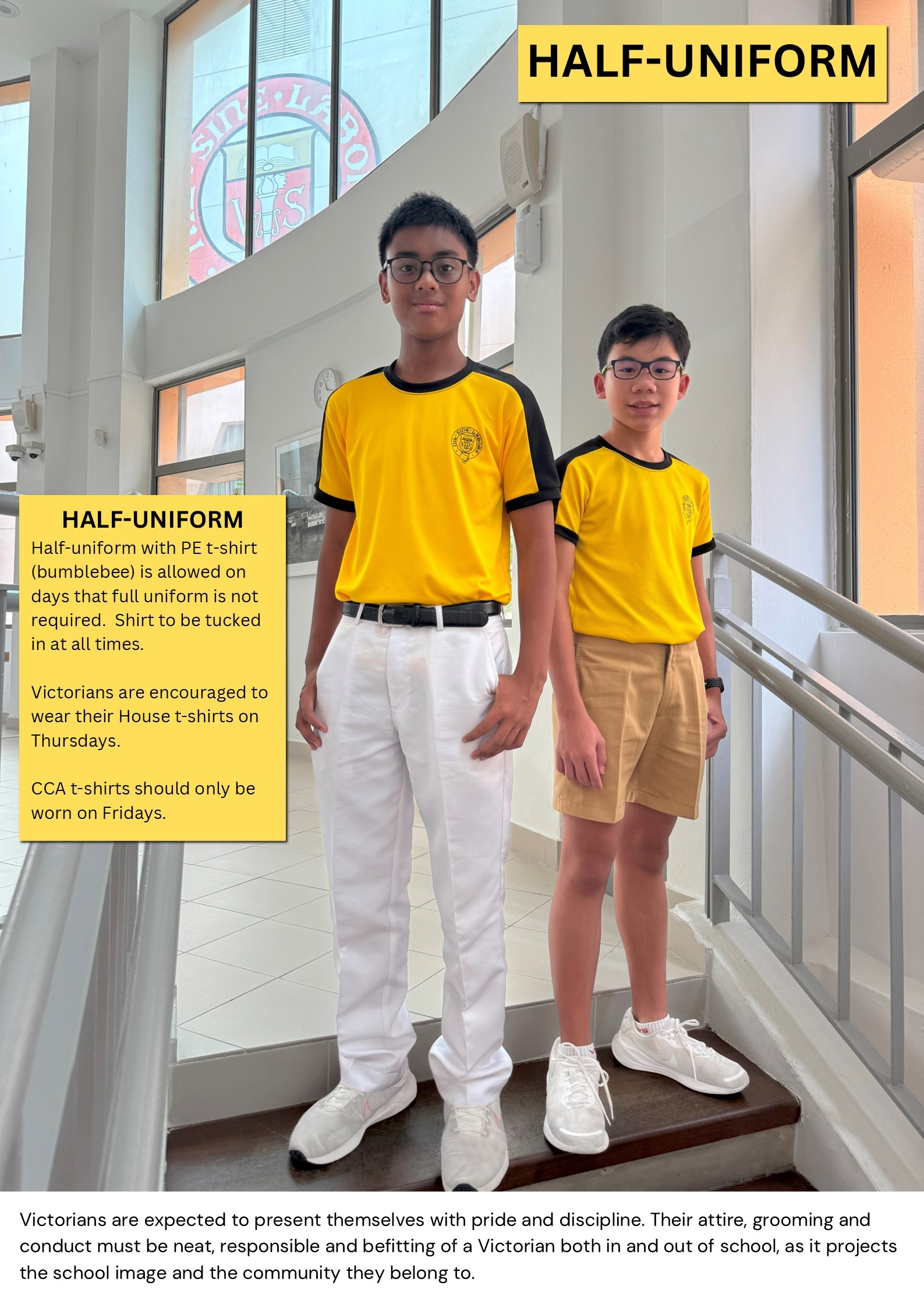
1.2 Victorians are to wear the prescribed school uniform with the school badge and modification to the uniform is not allowed. The school uniform should be purchased from the school bookstore to ensure the correct standard. Shirts must always be tucked. Upper Secondary Victorians must wear the prescribed VS belt or a plain black belt with their long pants.
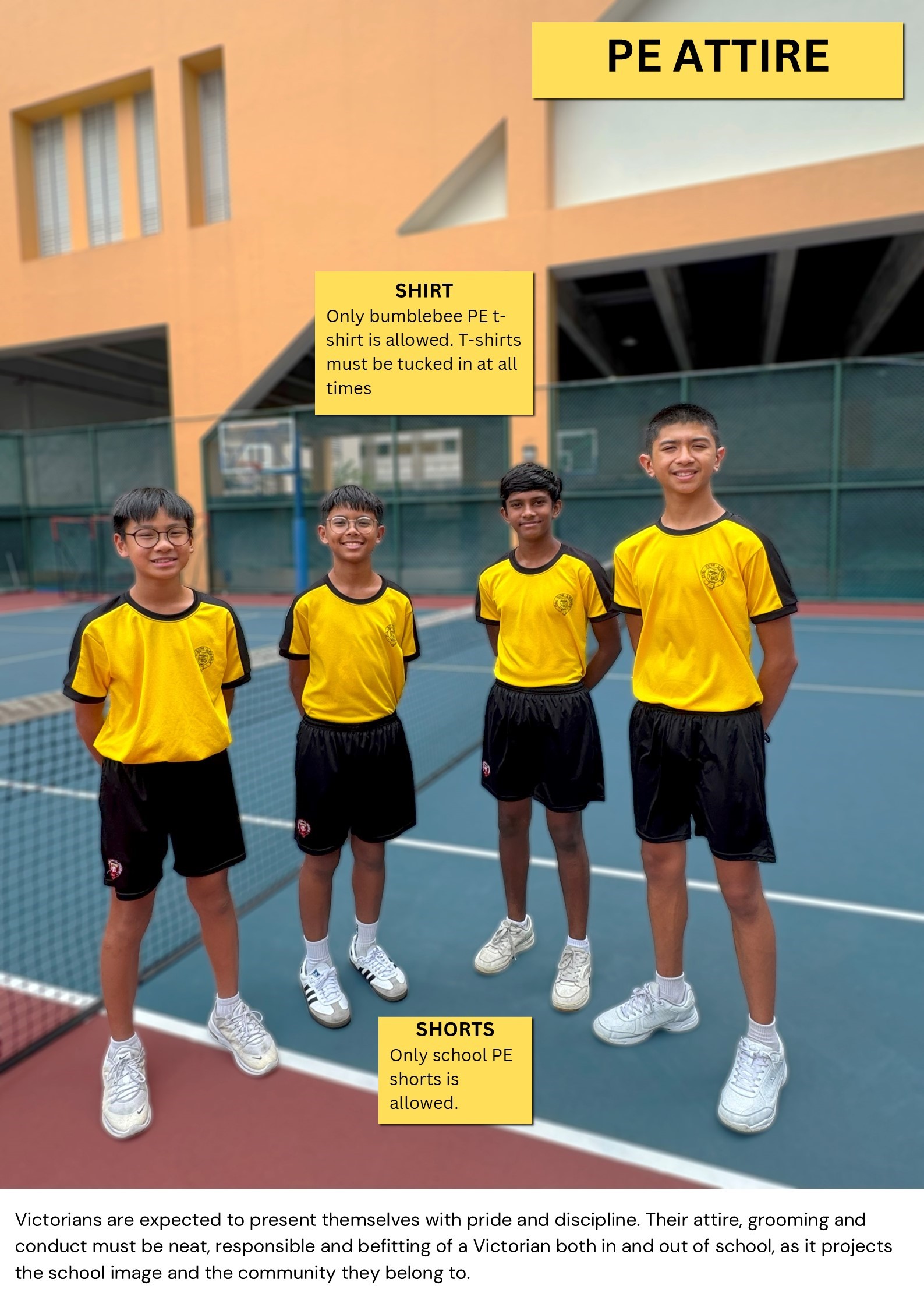
1.3 PE attire is to be worn during PE lessons, games and physical activities. For school-based activities on Saturdays and school holidays, PE attire, House T-shirts or school-based co-curricular activities (CCAs) T-shirts may be worn with proper shoes and socks.
1.4 Victorians must wear VS socks or plain white socks that fully cover the ankles, together with white shoes or predominantly white running/track shoes. Shoes must be properly laced with white shoelaces. High-cut shoes, outlandish colours and loud designs are not permitted.
1.5 The school tie must be worn smartly with the full school uniform at every Monday morning assembly, at all formal school functions and whenever required by the school.
Note: Refer to Annex A for sample photographs on how a Victorian should be attired.
Personal Hygiene and Grooming
1.6 Victorians should keep to a high standard of personal hygiene and grooming. Hair must be kept short, neat and tidy, with a slope at the back. When combed down, it must not reach the eyebrows, ears or shirt collar, and sideburns must not extend below mid-ear. Hair must be of natural colour and free from dyeing, tinting, perming or outlandish styles.
1.7 Victorians must be clean-shaven and facial hair (moustache or beard) is not allowed.
1.8 Victorians are not allowed to wear earrings, studs, body piercings, ear sticks, or any form of jewellery or accessories. The school reserves the right to decide if an item is inappropriate.
1.9 Victorians must keep their fingernails clean and short. Body decorations such as tattoos are strictly prohibited. Any Victorian found with them may be suspended until removal efforts are made.
1.10 Routine attire and personal grooming checks may be conducted anytime during the school term. Victorians who repeatedly fail to act on advice and reminders from teachers will face disciplinary consequences.
2. Attendance and Learning
2.1 Victorians are expected to take their learning seriously. They must be punctual and present for their lessons, CCAs and other activities.
Attendance and Punctuality
2.2 Attendance in school is compulsory. Absence must be supported by a Medical Certificate (MC) issued by a certified medical practitioner or a parent’s letter for exceptional family reasons.
2.3 All Victorians are to report punctually at the designated venues for morning flag-raising assembly by 07:30 (except 08:30 on Thursdays), unless otherwise informed. Reporting after these times constitutes late-coming.
2.4 Victorians must attend all lessons punctually and conscientiously. They may only leave school during curriculum time with written permission from the Form Teacher, or from the school management if unwell.
Respect, Responsibility and Discipline in Learning
2.5 Victorians greet their teachers and guests respectfully, use appropriate tone and behaviour in class, and seek permission before leaving the classroom or moving during lessons.
2.6 Victorians maintain order and discipline in their learning by keeping classrooms clean, restoring classroom order at the end of lessons, and switching off lights and fans when not in use.
2.7 They contribute to a positive learning environment by participating actively and responsibly in class and group work, and by always showing attentiveness and respect.
2.8 Victorians take ownership of their learning through regular review of lesson materials. They use Personal Learning Devices and ICT resources responsibly, solely for the purpose of learning.
2.9 Victorians complete and submit homework and assignments on time. They uphold academic integrity by not copying or allowing others to copy their work.
[Refer to Section 4 for digital responsibility.]
3. School, Community and Environment
3.1 Victorians are expected to contribute positively to the school and wider community. They build a culture of empathy, kindness, respect, responsibility and harmony by the way they treat one another and care for their shared environment.
Respect and Inclusivity
3.2 Victorians foster positive relationships built on respect, kindness and empathy. They cooperate with their peers, support one another in learning and CCAs, and show respect to teachers, staff and visitors. They do not engage in bullying, exclusion or behaviour that harms the dignity of others.
3.3 Victorians uphold proper decorum during assemblies and school events, recognising that their conduct reflects the values of the school community.
Care for Environment and Property
3.4 Victorians take pride in their school by keeping the environment clean and treating property with care. They also practise environmental consciousness by using resources responsibly and supporting sustainability efforts. This includes reducing waste, reusing items where possible, and recycling appropriately.
3.5 Victorians share responsibility for maintaining a safe and pleasant environment for all. They take care of their belongings, and when they find items that are not theirs, they hand them to a teacher or submit them at the General Office.
Community Spaces
3.6 Victorians consume food and drinks only in the canteen; only plain water is permitted elsewhere in the school compound.
3.7 Victorians queue in an orderly manner and exercise patience and courtesy in the canteen. They return utensils, dispose of leftovers responsibly, and leave tables and shared spaces clean for others.
4. Citizenship, Digital Responsibility and Safety
4.1 Victorians are expected to act as responsible citizens. They uphold the duties of a citizen, use technology wisely, and ensure the safety of themselves and others.
Citizenship
4.2 Victorians who are Singapore citizens must sing the National Anthem and take the Pledge. Students will take the Pledge with the right fist placed over the heart. Victorians of other nationalities are to stand at attention as a mark of respect.
Digital Responsibility
4.3 Victorians adhere to school rules on the storage and use of their handphones and Personal Learning Devices (PLDs). Handphones may only be used in accordance with school guidelines, and PLDs are to be used solely for the purpose of learning. Students must ensure their PLD is fully charged before bringing it to school; charging is permitted only in the school library during recess or after-school hours.
4.4 Victorians safeguard their devices. In the event of loss or theft, they must make a police report and inform the school. All PLDs are installed with a Device Management Application (DMA) to support a safe and conducive learning environment. Students must not uninstall or de-enrol the DMA, or attempt to access data and systems without authorisation.
4.5 Victorians interact online with respect and responsibility. They must not post remarks that are racially or religiously insensitive, vulgar, offensive or hurtful. They must not use any devices to create, store or share inappropriate content, or to make threats, cause harassment, impersonate or intimidate others.
4.6 Victorians respect intellectual property and digital integrity. They must obtain explicit permission from the content owner before downloading, copying, sharing or using copyrighted materials. They must not use, copy or share digital files in an unauthorised or illegal manner.
4.7 Victorians harness Artificial Intelligence and other technological tools ethically and responsibly. These tools are to support, not replace, their learning. Sources must be properly acknowledged and annotated.
Safety
4.8 Victorians are responsible for their own safety and that of others. They must not disregard safety rules or engage in behaviour that endangers themselves or others.
4.9 Victorians are not allowed to have in their possession any weapon. They are also not allowed to bring any weapon-like item which can be used or intended to be used to cause harm to others.
5. Consequences and Serious Offences
5.1 Victorians are expected to take responsibility for their actions. They are accountable for their conduct, and consequences will be applied fairly to guide learning and growth.
Consequences
5.2 A Victorian’s Conduct Grade is included in their semestral report slip. It is determined based on a holistic evaluation of the student’s overall behaviour throughout the semester.
5.3 A Victorian’s Conduct Grade will be considered in the application of scholarships, leadership appointments and representation of the school for external activities and programmes. If a Victorian is nominated for an award or opportunity, both within and beyond the school, his Conduct Grade will be considered before the nomination is endorsed.
Serious Offences
5.4 Parents/Guardians will be informed for serious offences. Further actions such as detention, suspension, caning or expulsion may be taken by the school.
5.5 Serious offences include, but are not limited to: disruptive behaviour, truancy, bullying, cyberbullying, cheating, forgery, open defiance, theft, vandalism, assault, gambling, substance abuse, possession of weapons, and other actions listed in Annex B.
5.6 Criminal offences will be referred to the Police.
Annex A
Annex B Examples of Minor and Major Offences
Minor Offences
Attendance
1. Late coming –
Being frequently late for school without valid reasons.
2. Skipping classes –
Wilful absence from formal lessons (including remedial) without a valid
reason.
Misconduct
1. Improper attire and personal grooming –
Disregarding school rules on attire, haircut, hairstyle etc. Modification of school uniform is considered a major offence.
2. Littering –
Deliberate dropping or leaving rubbish within school premises or public
places.
3. Using of vulgar language –
Verbalising coarse or abusive language (including online communications)
against fellow Victorians and / or staff.
4. Inconsiderate behaviour –
Eating and drinking outside designated areas (school and in public), not
following the rules of taking of lift, inconsiderate behaviour in public.
5. Sneaking into school after morning assembly –
Deliberately avoiding / reporting to designated school personnel in-charge
of late-coming, Deceitfully evading detection by running away.
Major Offences
Attendance
1. Truancy –
Being absent from school without a valid reason on school days (Mon – Fri).
2. Leaving school grounds without permission –
Leaving school grounds after reporting but before the end of the school
(12:30pm) without approval.
Misconduct
1. Bullying / Cyberbullying –
Hurting, frightening or intimidating others repeatedly to
deliberately cause harm, distress or humiliation. It can either be physical,
verbal or psychological in nature. This includes cyberbullying.
2. Cheating in assessments/tests/exams –
Possessing any unauthorised items, copying from others, allowing others
or colluding with others to copy/cheat during assessments. Tampering
with marks or answers after scrips have been marked or returned.
3. Disruptive behaviour –
Interfering with the smooth running of class or school events despite repeated
reminders and warnings.
4. Forging or Doctoring documents –
Forging adult signatures, medical certificates, consent forms etc with
the intention to deceive.
5. Open defiance and/or rudeness –
Repeatedly refusing to conform to school rules, norms and practices; disobeying
teachers’ instructions; displaying rudeness and disrespect in speech and
/ or body language.
6. Using language or behaving in a manner detrimental to the moral tone expected of a Victorian Gentleman, Sportsman, and Leader –
Speech or actions that negatively affect the values, culture or ethical
environment of Victoria School such as disrespectful or offensive behaviour,
or other behaviours that undermine the school values.
Theft/Damage of Property
1. Arson –
Planting explosives or setting property on fire, whether attempted or actual.
2. Theft/Stealing –
Stealing school property or property belonging to others. This includes
taking personal belongings without the permission of the owner.
3. Vandalism –
Deliberate destruction or damage to school or personal property such as
writing graffiti, drawing or painting on it.
Other Serious Offences
1. Assault –
Attacking others violently, whether causing injury or not.
2. Fighting –
Being involved in a physical altercation between individuals or opposing
groups in which each attempts to harm or gain power over the other, with
bodily force or weapons.
3. Gambling/Betting –
Using money in games, betting, etc
4. Gangsterism –
Being involved in a gang assault/threat/harassment/extortion, whether actual
or attempted
5. Pornography –
Consuming/possessing/distributing/selling pornographic materials (print
or online)
6. Possession of weapons –
Possessing weapons (including weapon-like items) that may be used or intended
to be used to cause harm to others.
7. Sexual Misconduct –
Being involved in attempted rape, outrage of modesty, underage sex, sexual
grooming, voyeurism etc.
8. Smoking/possession of cigarettes –
Using/possessing/distributing/selling cigarettes
9. Vaping –
Using/possessing/distributing/selling vaporisers and / or their accessories.
10. Substance abuse / Misuse of drugs – Consuming/possessing/distributing/selling
alcohol, drugs, inhalants or any other illegal substances.
11. Outrage of modesty – Assaulting/using
force on another person with the intent to outrage their modesty (includes
molestation, groping, and other forms of unwanted physical contact)
12. Video and ICT abuse – Gaining
unauthorized access to computers, modification of data, and causing interference
with computer use. This includes the distribution of harmful online content
and hacking.
13. Illegal filming with criminal intent – Taking
videos/photos without consent, especially in private or sensitive settings
(e.g., toilets, changing rooms, classrooms), with the intention to harass,
embarrass or threaten the victim. May also include distributing the footage
or for any exploitative purposes.
14. Tattoos and all forms of body art –
Having tattoos or body art that are permanent.
Annex C Disciplinary Consequences
We will adopt a restorative approach when addressing misbehaviour and misconduct of Victorians. Students will be counselled and they will reflect on their wrongdoing. Repeat offenders who ignore the restorative approach taken by the school will face more serious consequences.
Examples of Follow-Up Actions/Consequences
1. Reflection and counselling by Teacher/Counsellor:
The teacher/counsellor will help students to reflect on their actions,
to bring about a change in behaviour or attitude.
2. Engaging Parents/Guardian:
The school believes in partnering parents to support Victorians who demonstrate
behavioural problems or discipline issues. The school will engage parents/guardians
throughout the process when managing students. For Victorians who have
committed a serious offence, his parents/guardians will be invited to the
school for a discussion.
3. Cap on Conduct Grade:
The Conduct Grade reflects the holistic assessment of student behaviour
over each semester. Students who have committed major or serious
offences will be given a Conduct Grade no better than “Fair” for that semester.
4. Warning Letter:
The school may issue a warning letter to Victorians through the parents/guardian,
stating further consequences should the student continues to violate the
school rules.
5. Detention/School Service:
Detention/Corrective Work is a consequence for minor offences and takes
precedence over CCA and enrichment lessons. Victorians are expected to
exercise accountability by informing relevant teachers should they be absent
from CCA and enrichment lessons.
6. Academic Consequence:
Victorians who do not adhere to the instructions and regulations of school-based
assessments and examinations may be awarded zero marks for
the question / paper in which he flouted the rules and regulations. This
may impact his overall grade and subsequent MSG/GPA.
7. Suspension from Class/School:
Depending on the nature of the offence, an errant Victorian may be suspended
from class or school for a stipulated period.
8. Caning:
Caning may be administered on Victorians who have committed major offences.
Only the Principal or staff authorised by the Principal may administer
the caning.
9. Expulsion: Expulsion
from school may occur for very serious offences or cases
where the student’s conduct severely undermines safety, trust, or the school’s
ability to manage the student.
10. Referral to Law Enforcement Agencies:
There may be occasions when the school will have to seek the assistance
of the Singapore Police Force, Central Narcotics Bureau or other law enforcement
agencies when it is required by law or when the safety and security of
students and staff are at risk.
11. Police Case: In
cases where a Victorian is involved in a police case, the school will take
the necessary disciplinary action after the police have concluded their
investigations.
12. Disciplinary Record:
A disciplinary record will be kept in each Victorian’s dossier. Details
of the nature of the offence and the disciplinary action taken will be
recorded. A Victorian with a poor disciplinary record will not receive
a testimonial or be considered for award nomination. His Conduct Grade
will also be impacted.
The list of offences and disciplinary consequences stated above are not exhaustive and are subjected to changes.
Consequences may be meted out which could include a combination of measures in proportion to the nature, intent and gravity of the offence(s) committed by a Victorian.